
During a normal semester, the Ivy Tech Honor College’s Global Education Coordinator of English, Emily Watson, would have taken a group of students to New Harmony, Indiana, for a cultural experience filled with opportunities for research in history, architecture, art, literature, geography and more. Unfortunately, travel for the spring 2020 semester has been cancelled due to COVID-19, but students can get a glimpse into this extraordinary city with this paper written by Honors College student, John Adams.
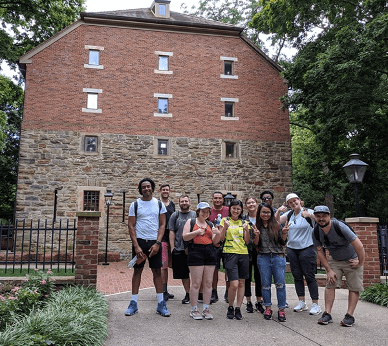
Reflecting on New Harmony
by John R. Adams
When I first heard about New Harmony about 10 years ago, I heard that it was historically a utopian society about an hour outside of Evansville and that it was quaint and pretty. Though that description is not inaccurate at all, it certainly does not give any justice to the experience that I had when I was there.
The town itself is beautiful with a unique variety of examples of period architecture, monuments, and one of those charming main streets that seems to utter stories of its provenance. Its location on a peaceful and alluring bend of the undeveloped Wabash River make its landscape a sublime backdrop that encourages you to take many contemplative walks. On such a walk you would have to be staring at your feet while walking down North Street to miss the distinctive blend of architecture, ranging from 18th century primitive cabins to Victorian mansions to a radically progressive 21st century oeuvre of architect Richard Meier.
On the same street you would find a roofless interdenominational church (which is really a walled open-air plaza with modern statuary and with a curved parabolic dome with an oculus), a labyrinth (not New Harmony’s only one by the way), an oculus (yes, another oculus), and a healing palindrome (kudos to you if have any idea what that even means). This town is as quiet as its people are friendly and all of these factors alone would make for a remarkable destination for retreat.
All of that is not even to mention its unique, historical richness. A significant portion of the New Harmony is a well-curated historical museum co-managed by the Indiana State Museum and the University of Southern Indiana. Restored houses, buildings, and thoughtfully repurposed outdoor public spaces in combination with art galleries and installations make up the majority of the commercial section of town. And, from my experience, if you take time to chat with the affable locals, you could easily be swept into their own personal art studio and home just because you said hello and expressed interest in their hometown.
This is where the experience factor of travel becomes the make or break part of any trip. If I could only give one insight for how to get the most out of a travel experience I would say pack light. What I mean by this is that all you really need is some underwear, a toothbrush, and an open mind. A willingness to let things happen will give you the possibility to transform your trip from a boring vacation to a lifelong memorable experience. If I could be allowed to make one more suggestion it would be to find a cozy bar, pony up sometime in the afternoon when its not very busy (which might be anytime in New Harmony) and strike up a conversation with your bartender. 99% of the time, your bartender is going to be friendly (its their job) and have a pretty good idea of where you can have a good time well off the beaten tourist path.
As for New Harmony, there really is not the much beyond the beaten path by nature of its small scale, but we did find experiences through meeting people that we could not have otherwise had without having such a chance encounter.
This was how we met Docey Lewis. But first, let’s back up and introduce another important character from this trip.
A lot of the museum stuff and art galleries are only accessible with a proper guide and, after having Linda Warrum as ours, I would be hard pressed to imagine anyone being better suited. Warrum is a historian with USI and is without a doubt, the leading authority on the history of New Harmony. She spent hours with us touring around the essential buildings, art galleries and significant sites around town giving us comprehensive explanations and expounding on detail upon detail.
As described above, we met Docey Lewis at Sara’s Harmony Way, a coffee bar with an adjacent wine bar, while having a pint of Harmonie dark lager and chatting up (or being chatted up, rather) by our bartender. As it turns out Lewis has her textile studio on the second story up above Sara’s. She spotted us and warmly invited us up for a tour and to come to her house across from the Roofless Church to see her living mask of Robert Dale Owen’s bust.
We decided that this would be great for the whole class to do and exchanged contacts.
The next day on another tour with Linda, we ran into Docey and secured our plans to visit her studio and home. This was of course, way more enlightening than just a visit.
Docey Lewis is one of those people that expand your idea of what a single person can achieve in their lifetime. It was almost dizzying trying to follow the trajectory of her career as a weaver. Specializing in textile, she traveled the world sourcing material directly from the towns and villages where they are produced.
Working with the locals form places like Madagascar, Nepal, and Bangladesh, where she not only bolstered the economy of remote villages, but in some cases built them schools and infrastructure with which they could have a clean, safe, and productive society while producing sustainable textiles that she could sell to Pottery Barn, World, and the White House (during the Obama Administration) just to name a few examples. She inspired us with stories of how she grew her business and the trials, tribulations, and successes that she had experienced all over the world. (Tyler, 2018)
On a trip that is not over-planned, you leave yourself open to a chain of happenstance experiences. Because we weren’t obligated to be going from point A to Point B with an itinerary that had been chiseled in stone six months in advance, we were able to meet with another artist living in New Harmony on Lewis’s recommendation.
Enter Ben Nicholson.
Nicholson is Associate Professor at the School of the Art Institute of Chicago, an author, and an expert in the primitive geometry of labyrinths (which is how he found his way to New Harmony). Nicholson fell in love with New Harmony when attending a Labyrinth Festival while he was immersed in the studying of labyrinths.
In his studio, where we were all asked to remove our shoes and check our bags and cell phones outside, he told us that he had suffered some type of midlife crisis after being involved in some sort of ridiculously and impossibly complicated architectural project that never came to fruition and it was then that he decided to spend the next portion of his career studying labyrinths.
He explained this decision was because he had discovered that they were the most elemental expressions of minimalist architecture and that they have been created universally throughout ancient to modern history in nearly all peoples and cultures in one way or another. His studio was strewn with hundreds of precisely drawn examples of every known style of labyrinth from every ancient culture you could think of from the Greeks, Romans, Druids, Chinese, Meso-American, you name it.
Nicholson had us sit in a circle of vintage chairs which he collected, each one having significance and provenance including one from a B-2 bomber worth fifty grand or something like that. We had a philosophical discussion on labyrinths, guns and I think we discussed the entomology of art in some way, but I was really too dazed by the experience to fully recall the details of the discussion.
He then took us to his house where he had built his own labyrinth and he managed to get us all to walk it, spaced 10 paces apart, taking our time, and contemplating the meaning of the whole thing as we did it. He also had an interesting artistic and philosophical fetish for guns and if we would have had more time, we would have enjoyed the use of his shooting range which he mentioned was the perfect compliment to a walk in the labyrinth.
We saw the archives of the Workingman’s Institute and of another part of the Indiana State Museums holdings. We were able to make use of the former for research, which I did indeed. The Workingman’s Institute was originally a school in the second utopian effort in New Harmony, now it functions as a landmark, library, and museum of art, artifacts, and oddities.
What I took away from this experience more than anything was affirmation of something that I already knew, yet something that we all need to be reminded of more often and I believe Anthony Bourdain said it best. “It seems that the more places I see and experience, the bigger I realize the world to be. The more I become aware of, the more I realize how relatively little I know of it, how many places I have still to go, how much more there is to learn.” (Kachroo-Levine, 2019)
It is remarkable to be reminded of this while traveling within Indiana.
I neglected to get very specific about the historical details about New Harmony because there is so much to it that it is impossible to be brief and do it any justice. However, it is that history in New Harmony and how it is regarded that reinvigorates a deep appreciation and embrace for the humanities and man’s effort to keep trying to get it right. In New Harmony, there is a tangible vibe, which is a mélange of intellectuality, humanism, philanthropy, and benevolence mixed with peace, tranquility, and personal spirituality. That vibe is contagious. It’s why people like Docey Lewis and Ben Nicholson live there. Its why the town is full of friendly people that want to share its magic with you. The New Harmony vibe infected me deeply and left me buzzing after I returned. I cannot wait to go back with my family to share it with them although I know that I had an experience that can never be precisely duplicated; that’s the whole point.
 Ivy Tech Indianapolis News
Leave a comment